

You probably know 4K is associated with top-quality videos, but you're not sure exactly what it means. In this article, we will cover everything you might want to know about 4K resolution. Don't worry, it's nothing techy. At the end of the article, we will also show you how to upscale videos to 4K for cinematic playback.
Part 1. An Overview of 4K Resolution
What does 4K mean?
4K resolution, as the name suggests, refers to widescreen video that has about 4,000 pixels horizontally. The total pixel count of 4K resolution videos is more than 8 million. There are 2 main formats based on the exact aspect ratio and use cases: 4K UHD and DCI 4K.
4K UHD is in a dimension of 3840×2160, with a 16:9 aspect ratio. It's often used for TVs, streaming, and most common 4K content.
DCI 4K resolution is 4096×2160 in size, which is a 1.9:1 aspect ratio. It's a professional standard for cinema.
Other non-standard 4K resolutions exist, but 4K UHD and DCI 4K are the ones you'll see most often in daily use. You use 4K UHD every day for streaming at home, while you watch DCI 4K in the movie theater.
| Feature | 4K UHD | DCI 4K |
| Full name | 4K Ultra High Definition | Digital Cinema Initiatives 4K |
| Size | 3840 × 2160 | 4096 × 2160 |
| Total Pixels | About 8.3 million pixels | About 8.8 million pixels |
| Aspect Ratio | 16:9 (1.78:1) | 17:9 (1.90:1) |
| Primary Purpose | Consumer video and displays | Professional cinema production and projection |
| Common Uses | 4K TVs, monitors, YouTube, Netflix, gaming consoles, consumer cameras | Movie theaters, digital cinema projectors, film production, cinema mastering |
| Common Devices | TVs, laptops, desktop monitors, smartphones, home projectors | Cinema cameras, professional editing systems, theater projectors |
| Typical Export Option | "3840×2160"/"UHD 4K"/"2160p" | "4096×2160"/"DCI 4K" |
Part 2. 4K vs. 2K vs. 1080P vs. 720P vs. 360P
What is 2K?
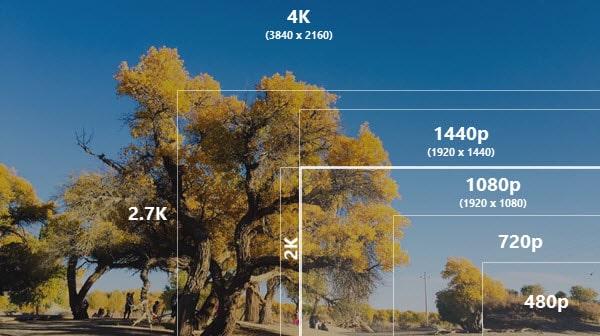
2K videos have a horizontal resolution of about 2000 pixels. Typically, there are 2560×1440 for the monitor resolution (also called QHD/1440p for most of the time) and 2048×1080 for the cinema. In daily use, QHD is popular for high-res PC gaming, but less common on TVs.
What is 1080p?
1080p videos have a resolution of 1920×1080, and a standard aspect ratio of 16:9. It's one of the most widely used resolutions for videos, because it maintains a good balance between quality and file size. You can see this type of video on YouTube, Blu-ray, online meetings, gaming, and more.
What is 720p?
720p refers to the 1280×720 resolution. It has a smaller file size, requiring fewer system resources. It also needs a relatively low bandwidth, so it works well on slow Internet. But on large screens, you might find a 720p video looks soft or blocky, for the pixels per inch (PPI) get reduced.
What is 480p?
480p refers to videos that have a vertical resolution of 480 pixels. 640×480 (4:3), 854×480 (16:9), and 480×480 (1:1) are the most common dimensions. It's a standard definition for social media videos, DVDs, early YouTube videos, and old TV broadcasts. It contains much less detail than 4K and 1080p.
What is 360p?
360p, which is 640×360, is often considered a low resolution. It has only about 1/36 of 4K pixels. 360p is often used for highly compressed or bandwidth-saving videos, trading off quality for efficiency. The video is small in file size and loads quickly, but it looks very blurry on most modern screens.
Comparison of Common Video Resolutions
| Resolution | Common Dimensions | Pixels | Quality | Common Uses |
| 4K | 3840 × 2160 (16:9) / 4096×2160 (1.9:1) | 8.3 million | 5/5 | 4K TVs, YouTube, Netflix, cameras, gaming, cinema |
| 2K | 2560 × 1440 (16:9) / 2048 × 1080 (17:9) | 3.7 million / 2.2 million | 4/5 | Gaming, cinema |
| 1080P | 1920 × 1080 (16:9) | 2.1 million | 3/5 | Streaming, Blu-ray, webcams, TVs |
| 720P | 1280 × 720 (16:9) | 921,600 | 2/5 | Older HD videos, broadcasts, mobile streaming |
| 480P | 854 × 480 (16:9) / 640 × 480 (4:3) / 480 × 480 (1:1) | 410,000 | 1/5 | DVDs, older videos |
| 360P | 640 × 360 (16:9) | 230,400 | 1/5 | Low-bandwidth streaming, previews, compressed videos |
Part 3. Why Is 4K Best for Large Screens
A larger screen does not automatically mean a sharper video or image. Clarity depends on how many pixels are packed into the screen size and how far away you sit.
What Is Pixel Density and Why It Matters
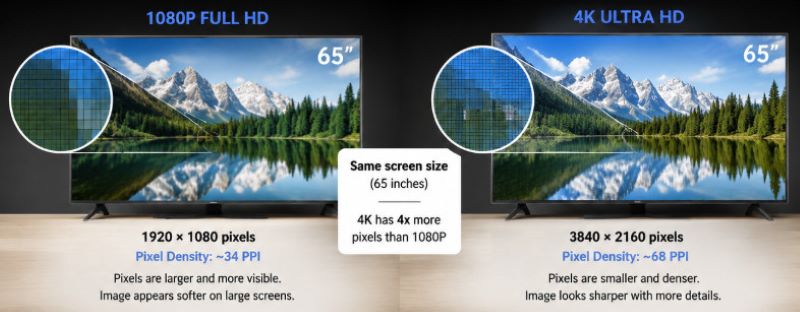
The pixel density, or pixels per inch (PPI), matters a lot for high-quality playback. Imagine two TVs showing the same video. When the screen is bigger, the same pixels are spread over a larger area, so they are stretched and softened, making the video blurry.
4K videos have about twice the pixel density of 1080p videos at the same screen size, which means remarkably smaller pixels, smoother edges, sharper text, and more detail. So, to maintain a high pixel density on large screens, 4K resolution is recommended.
How Does Viewing Distance Affect Quality
If you watch videos at a far distance, the differences between 1080p and 4K might feel insignificant. But when you sit close to the screen – imagine you watch a movie in your living room or on your desktop – the pixel differences become much more obvious.
4K makes sure the movie is enjoyable to watch at home, regardless of your screen size or your viewing distance.
Part 4. What Is the Relation of 4K and UHD
What does UHD mean? Technically, UHD (Ultra-high-definition) is a broader category that includes both 4K UHD and 8K UHD. But in everyday use, people often see "UHD" and "4K" as referring specifically to 4K UHD (3840×2160). This probably comes from marketing: many UHD TV manufacturers use the two terms interchangeably because consumers associate K with higher quality. So when you see either "UHD" or "4K" in product promotions, they almost always represent the 3840×2160 resolution.
Part 5. Best Way to Upscale Videos to 4K Resolution
Even if your original movie resolution is only 1080p or lower, you can still upscale it to 4K for a superb experience with AVAide Video Converter. This amazing software lets you convert your lower quality videos into 4K with all types of output formats. On top of that, AVAide Video Converter gives you many resolution options to choose from. What's more, its powerful toolbox permits you to edit, enhance, cut, and sync your videos and audio in a few clicks of your mouse.
- Upscale or downscale 4K videos in a few clicks!
- Support various formats for your 4K videos.
- Let you enhance the 4K videos with its intuitive interface like a pro.
- Provide excellent and powerful tools to edit your 4K videos, such as compressor, trimmer, reverser, etc.

 Secure Download
How to Upscale to 4K Resolution with AVAide Video Converter
Step 1Launch the software after the installation. You can acquire this tool on both Windows and Mac devices.

Step 2Once you click the Video Enhancer option, you will see a new window. On that window, hit the Plus icon to upload your video that needs to have a 4K screen resolution.

Step 3This time, you will see another window where the options of enhancing the video. As you see, there is this Upscale Resolution option. Toggle the empty box that it has. After that, move your cursor down and reach the Resolution selection. Click the arrow and scroll down to choose the 4096x2160 as the pixels to get a 4K video.

Step 4Check the changes you are about to make by clicking the Preview button. Subsequently, it will let you watch and see the difference in the video for ten seconds.
Step 5Now, feel free to choose a destination for your true 4K resolution video by clicking the downward arrow in the Save To option. Then, click the Enhance button anytime you are ready to obtain the changes.
Now you have successfully increased the video resolution. Click Convert All to save the result.

Part 6. FAQs Regarding 4K Resolution
Can I play 4K resolution videos on a phone?
Yes, most modern smartphones in the last decade can play 4K videos, locally or online.
Can I record 4K videos using a camera?
Yes, mirrorless 4K cameras can record videos in 4K. Some smartphones, like iPhone 13 Pro and later, can shoot 4K videos too. But keep in mind that 4K video files can be massive, so plan your recording duration carefully.
Can I downscale 4K videos to 1080p?
Yes. You can downscale 4K to 1080p in AVAide Video Converter by setting the output resolution to 1920 × 1080.
We have just explored the world of 4K videos. 4K resolution can greatly improve your viewing experience. In connection to that, you can use AVAide Video Converter to upscale non-4K videos easily.
ABOUT THE AUTHOR

The most comprehensive media converter to convert video & audio without quality loss.
Video Enhancement
- Upscale 1080p to 4K
- Upscale 480p to 1080p
- Downscale 4K to 1080p/720p
- Downscale 1080p to 480p
- Upscale DVD to 1080p/720p
- Fix Bad Quality Video
- AI Video Upscale
- Enhance Video Quality
- Improve TikTok Video Quality
- Best Video Enhancer
- Video Enhancer App for iPhone & Android
- Best 4K Video Enhancer
- AI Upscale Video
- Clean up Video Quality
- Make Video Higher Quality
- Make a Video Brighter
- Best Blur Video App
- Fix Blurry Videos
- Improve Zoom Video Quality
- Improve GoPro Video Quality
- Improve Instagram Video Quality
- Improve Facebook Video Quality
- Improve Video Quality on Anroid &iPhone
- Improve Video Quality in Windows Movie Maker
- Improve Video Quality in Premiere
- Restore Old Video Quality
- Sharpen Video Quality
- Make Video More Clearer
- What is 8K Resolution
- 4K Resolution: Everything Your Need To Know [Explained]
- 2 Amazing Ways to Increase Video Resolution Losslessly
- Video Resolution Converter: Things to Ponder in Getting One
- The Outstanding 5K to 8K Converter You Shouldn’t Miss!
- Remove Background Noise From Video: With Three Efficient Ways
- How to Remove Grain from Video Using the 3 Remarkable Ways