Got a 4K video that's too big for email? Or an old phone clip that looks soft on a big screen? Changing resolution is one of the most common ways to fix these problems, and you don't need paid software to do it well.
This guide walks through the 6 best video resolution converters in 2026. Desktop tools for when you care about quality and privacy, online tools for quick one-offs. Plus a simple way to pick the right resolution for your work.
Part 1. Quick Comparison: Choose Your Best Video Resolution Changer
- Tool
- HandBrake
- AVAide Video Converter
- VLC
- CloudConvert
- FreeConvert
- Free AI Video Enhancer
| Platform | What’s Good | Free Limit |
| Windows, Mac, Linux | Flexible quality control | Free |
| Windows, Mac | Customizable export settings, AI upscale and easy UI | Free trial allows videos up to 5 minutes |
| Windows, Mac, Linux | One-stop player and resolution changer | Free |
| Online | Flexible quality options | 10 free uses per day |
| Online | Simple, 1 GB free | 20 conversion minutes per day for free |
| Online | AI upscale that works locally | Free |
If the file is private or large, better to stay local. If it's a quick social clip and you don't mind uploading, an online tool is fine.
Part 2. Top 3 Video Resolution Converters on Desktop
1. HandBrake
HandBrake is the free, open-source standard for this job. It runs on Windows, macOS, and Linux. No ads, no account, no upsell. It re-encodes almost any input into MP4, MKV, or WebM and offers custom options for resolution, quality, and codecs (H.264, H.265/HEVC, AV1, and more).
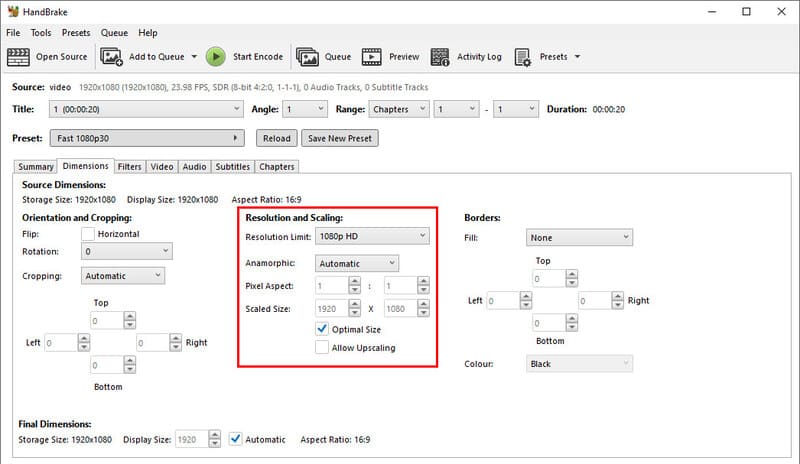
Best for: Those who want clean results and don't mind a slightly technical interface. Hardware encoding (NVIDIA, AMD, Intel, Apple Silicon) keeps it reasonably fast.
- Pros
- Completely free and open-source.
- Excellent quality control and support for modern codecs such as H.264, H.265, and AV1.
- Hardware acceleration keeps encoding fast.
- Cons
- Interface feels technical for absolute beginners.
- Export formats are limited to MP4, MKV, and WebM.
2. AVAide Video Converter
AVAide Video Converter is among the most feature-packed video converters for 4K resolution. It supports 1000+ formats, batch conversion, basic trimming and editing, and hardware acceleration. Two features matter for resolution work. First, the regular Format settings let you raise or lower video resolution and bitrate when you convert. You can pick a preset for a specific platform like YouTube or TikTok, or type a custom resolution for yourself. Second, the Video Enhancer under Toolbox uses AI upscaling. That one is very useful when you want to increase video resolution and recover detail rather than just stretching pixels.


FREE DOWNLOAD For Windows 7 or later
 Secure Download

FREE DOWNLOAD For Mac OS X 10.13 or later
Secure DownloadBest for: Beginners who need a simple interface plus highly customizable resolution options.
- Pros
- Broad format support.
- Clean, beginner-friendly interface.
- Easy custom controls for resolution, bitrate, codecs, etc.
- Presets for specific social media platforms or devices.
- Includes AI upscaling for sharper visual quality when increasing the resolution.
- Cons
- The free version is limited to 5 minutes for export. Full features require a paid license.
3. VLC
Good news for you if you already have VLC Media Player on your computer: VLC can also change video resolution without installing anything extra. It supports almost all common video formats, but sometimes fails on rare ones like DivX. It's not the best tool for batch or high-quality work, but for a one-off on a regular format like MP4 or MKV, it's convenient.
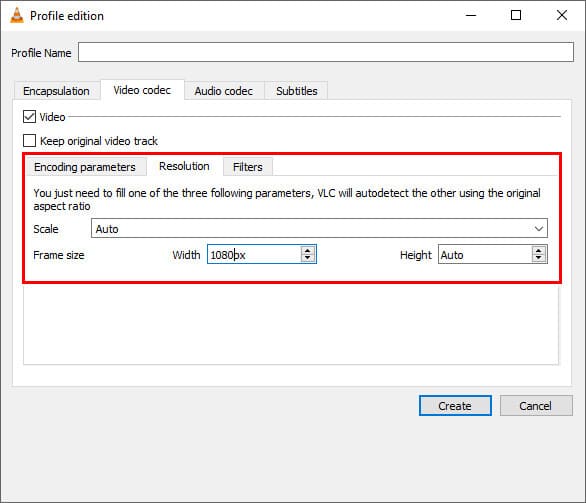
Best for: Computers with VLC already installed; quick resolution conversion for modern video formats.
- Pros
- Free with no ads or sign-up.
- Wide format support.
- Cons
- Interface for changing resolution is a bit buried and less intuitive.
- Limited quality and control compared with dedicated converters.
Part 3. Top 3 Video Resolution Changers Online
When you don't have extra storage for software or you just need one quick change, online tools are handy. The trade-offs are upload file-size limits and the fact that your video leaves your machine.
1. CloudConvert
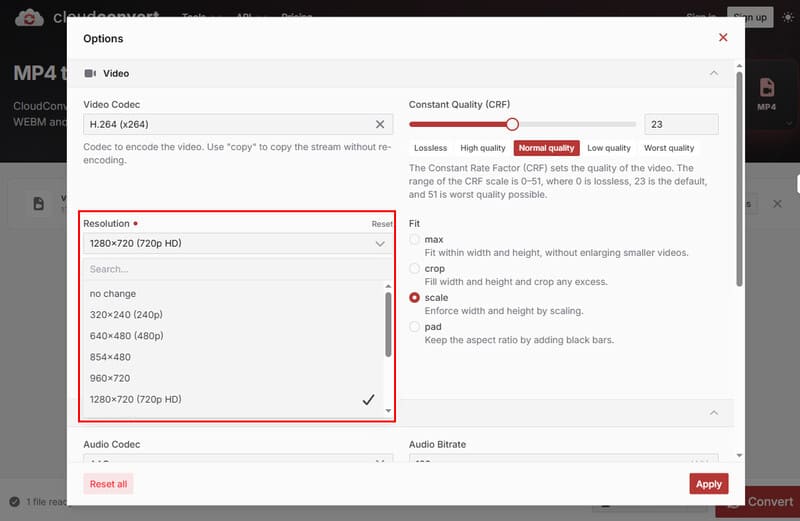
CloudConvert is one of the more reliable online converters. It supports a wide range of formats and lets you set resolution, quality (CRF), and other options. The free version is limited to 10 conversions per day, but the quality is good, and the interface is clean.
Best for: Quick online conversion with flexibility.
- Pros
- Clean interface with adjustable quality settings, including CRF.
- Supports a wide range of formats and advanced settings.
- Results are consistently good in most cases.
- Cons
- Has a daily conversion limit of 10 free uses.
2. FreeConvert
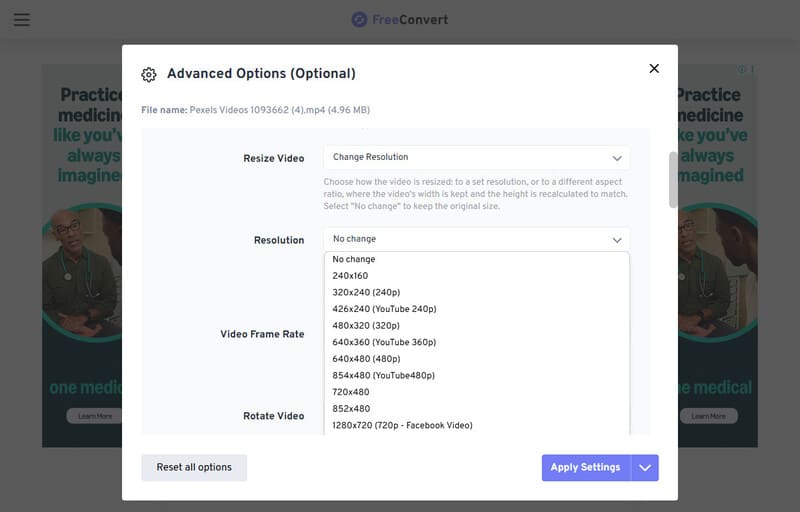
FreeConvert is also a browser-based tool to convert video resolution. It supports a 1 GB free limit with no account required for basic use. You can change resolution, bitrate, codec, and more. Although it's an online service, it uses 256-bit SSL encryption when transferring files and automatically deletes them after 8 hours, so your privacy is protected.
Best for: Simple, fast conversion on any device.
- Pros
- Simple and fast.
- Customizable image size, background color, and compression.
- API is available.
- Supports batch upload and conversion.
- Cons
- There are ads on the webpage.
- The free conversion is limited to 20 minutes per day.
3. Free AI Video Enhancer
Free AI Video Enhancer (free.upscaler.video/video-enhancer) is a free online video resolution enhancer. It runs in your browser, and the AI work happens on your own device using WebGPU, so your video stays private the whole time.
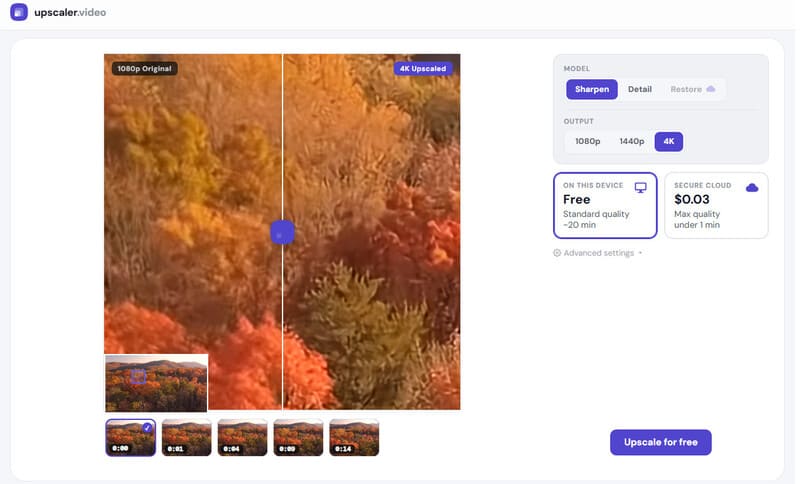
It's built for upscaling low-res clips, and you can push them to 1080p or 4K. It leans on models like Anime4K and RealESRGAN and does a good job sharpening edges.
Best for: Improving video quality online. Works especially well on animated content.
- Pros
- Free with no sign-up.
- Runs locally in the browser.
- Increases video resolution up to 4K and improves visual quality.
- Cons
- Doesn't let you reduce video resolution.
- Processing speed is tied to your own GPU, so it can take quite a while on average hardware.
- Only works with formats your browser can already play.
Part 4. Pro Tip: What Video Resolution Do You Need
More pixels aren't always better. What we need is a balance between clear detail and reasonable file size. Matching the resolution to where the video will be watched saves time, storage, and bandwidth.
- 4K (3840×2160): big TVs, high-end editing, or YouTube if you have the bitrate and the audience watches on large screens.
- 1080p (1920×1080): the everyday sweet spot for most phones, laptops, and web video.
- 720p (1280×720): still looks fine on phones and is much smaller. Good for messaging apps or older devices.
- 480p or lower: only when file size is the absolute priority or the source is already that soft.
A quick rule of thumb: if the video will mostly be watched on a phone, 720p or 1080p is usually enough. Going from 4K to 1080p cuts the pixel count by about 75%, which is why file sizes drop so dramatically.
Part 5. FAQs about Video Resolution
Does changing resolution reduce quality?
Downscaling (going smaller) is mostly fine and often looks cleaner because you're removing data the eye doesn't need at that size. Upscaling (going larger), on the other hand, can reduce quality. Simple upscaling just stretches pixels, while AI upscalers can do a better job of guessing detail, but the result still depends on the source.
Can I change resolution without re-encoding?
Not really, if you want a permanent change to the pixel dimensions. Remuxing just keeps the same video stream unchanged.
What's the fastest free option?
For one small file, an online tool or VLC is often quickest because there's nothing to install. For repeated work or large files, HandBrake and AVAide Video Converter with hardware encoding are usually faster overall.
Have you found the best video resolution changer for you? Start with HandBrake if you want it free and local. Use AVAide Video Converter when you need a more guided interface with AI upscaling. VLC or an online converter is better when you need it done fast in the next five minutes. Pick the resolution that matches the actual viewing size, keep the aspect ratio, and you'll get good-looking files without wasting space or time.
ABOUT THE AUTHOR

Your complete video toolbox that supports 350+ formats for conversion in lossless quality.