Music tags (also called ID3 tags or metadata) are the hidden info inside your audio files: title, artist, album, genre, year, track number, cover art, and more. Without them, your library can turn into a messy pile of "Track 01" and "Unknown Artist." A good music tag editor helps you organize them quickly.
This guide recommends 6 tools, from free batch editors to fully automatic collection cleaners and simple browser options. We'll look at what each one does well, where it falls short, and who it's best for.
- What Is a Tag in Music
- Part 1. Mp3tag – Best for Batch Tag Editing
- Part 2. MusicBrainz Picard – Best for Automatic Music Identification
- Part 3. AVAide Video Converter – Best for Straightforward Metadata Edits
- Part 4. Kid3 – Best Free Cross-Platform Editor
- Part 5. TagScanner – Best for Windows Library Cleanup
- Part 6. SongKong – Best for Automatic Collection Cleanup
- Quick Comparison Table for the 6 Music Tag Editors
- How to Edit Music Tags Safely
- FAQs About Music Tag Editors
What Is a Tag in Music
A music tag is a piece of metadata embedded in an audio file. You can think of it as the digital equivalent of the info printed on a CD case or vinyl sleeve. It usually includes:
- Title, Artist, Album, Album Artist
- Genre, Year, Track number, Disc number
- Composer, Lyrics, Comments
- Album artwork (cover image)
These tags are inside the file itself, often as ID3 tags for MP3, Vorbis comments for FLAC/Ogg, or MP4 atoms for M4A. Players and file explorers read them so you can sort and search your music properly. Bad tags make large collections painful to manage. That's where a dedicated tag editor comes in.
Part 1. Mp3tag – Best for Batch Tag Editing

Mp3tag is one of the most popular dedicated tag editors, especially on Windows. You can edit tags, rename files based on them, do find/replace on text, export tag data, customize the layout, and create playlists.
Main downsides: no support for viewing or editing synced lyrics, and regular lyrics are capped at 6 lines with no way to expand that.
Overall it's a reliable tool for organizing music libraries, whether you're a casual listener or a serious collector.
Best for: Windows users who want a free, fast, no-nonsense batch editor; and people who already have a large mixed-format library.
Platforms: Windows (free), macOS (paid, with native Apple Silicon support)
Supported formats: MP3, FLAC, OGG, OPUS, M4A/MP4, WMA, WAV, AIFF, APE, MPC, WV, DSF, TAK, TTA, WebM, Matroska, and more
- Pros
- Excellent batch editing and file renaming
- Strong online database support (Discogs, MusicBrainz, custom sources)
- Flexible actions for repetitive tasks
- Free and lightweight on Windows
- Good cover art handling
- Cons
- The Mac version is paid
- Interface feels a bit dated to some users
- Steeper learning curve for advanced actions
Part 2. MusicBrainz Picard – Best for Automatic Music Identification

MusicBrainz Picard is the official open-source tagger for the MusicBrainz database. It excels at creating accurate, community-maintained metadata. Picard uses AcoustID fingerprints, so it can identify tracks even when the existing tags are wrong or missing. It works album-by-album, which helps keep consistency across a release.
Version 3.0, released in 2026, brought a Qt6 rebuild, a new plugin system, better matching, native Apple Silicon support, and synced lyrics support.
Best for: The most accurate tags from an open database; people organizing large, mixed, or poorly tagged collections.
Platforms: Windows 10+, macOS 13+, Linux
Supported formats: MP3, FLAC, OGG, M4A, WMA, WAV, and most common formats (Matroska support is limited)
- Pros
- Highly accurate tagging via MusicBrainz + AcoustID
- Strong album-oriented workflow
- Plugin system and scripting for customization
- Free and open source
- Good cover art and file renaming options
- Cons
- Steeper learning curve than simpler tools
- Needs internet for full features
- Can struggle with very obscure or non-standard releases
- UI can feel complex for beginners
Part 3. AVAide Video Converter – Best for Straightforward Metadata Edits

AVAide Video Converter is a one-stop editor for video and audio, and it contains a Media Metadata Editor in its toolbox. You can edit common fields like title, artist, album, composer, genre, year, track, and comments, and add cover art from a local image. It supports 100+ audio formats such as MP3, WAV, AAC, FLAC, WMA, and OGG, and it runs on both Windows and Mac.
It's not a dedicated powerhouse like Mp3tag or Picard, but the interface is clear, and it has powerful conversion and many other multimedia editing features.
Best for: Users who want a simple metadata editor with wide format support and no learning curve
Platforms: Windows 7+, macOS 10.13+
Supported formats: MP3, WAV, AAC, FLAC, WMA, OGG, and additional formats handled by the converter
- Pros
- Simple, beginner-friendly interface
- Works on both Windows and Mac
- Supports common audio formats plus cover art
- Part of a broader media toolkit
- Cons
- No deep online database matching like Picard or Mp3tag
Part 4. Kid3 – Best Free Cross-Platform Editor
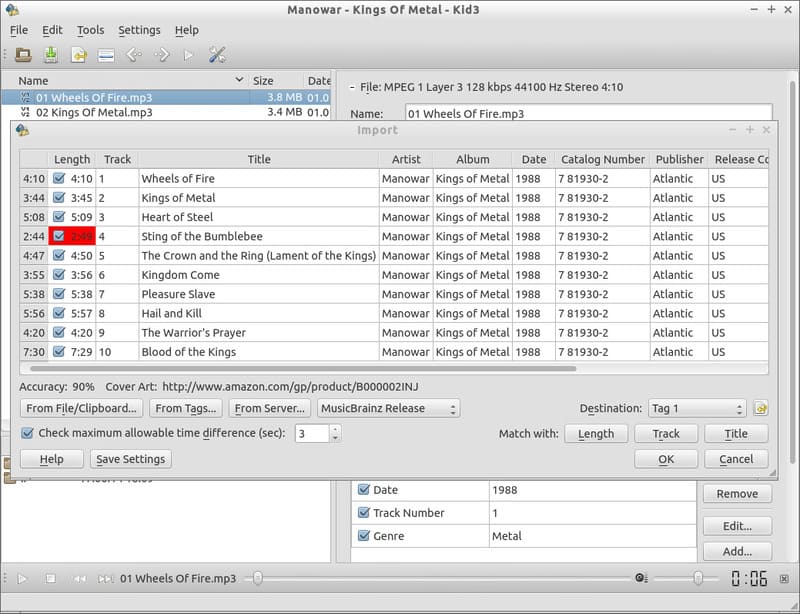
Kid3 is a free, open-source, cross-platform tag editor that supports a very wide range of formats. It lets you edit ID3v1/v2, convert between tag versions, batch-edit multiple files, generate tags from filenames (and vice versa), and pull album data from MusicBrainz, Discogs, Amazon, and others. It also handles synchronized lyrics and has a command-line interface for automation.
Because it runs on Windows, macOS, Linux, and even Android, it's a good choice if you need to switch devices for your project.
Best for: Cross-platform users, Linux users, and those who need broad format support and batch tools without paying.
Platforms: Windows, macOS, Linux, Android
Supported formats: MP3, FLAC, Ogg/Vorbis, Opus, MP4/M4A, WMA, WAV, AIFF, APE, MPC, WavPack, DSF, Matroska/WebM, TrueAudio, tracker modules, and more
- Pros
- Truly cross-platform (including Android)
- Very wide format support
- Batch editing and filename/tag conversion
- Online album data import + AcoustID support
- Free and open source
- Cons
- Interface looks a bit dated
- Advanced features take some learning
Part 5. TagScanner – Best for Windows Library Cleanup
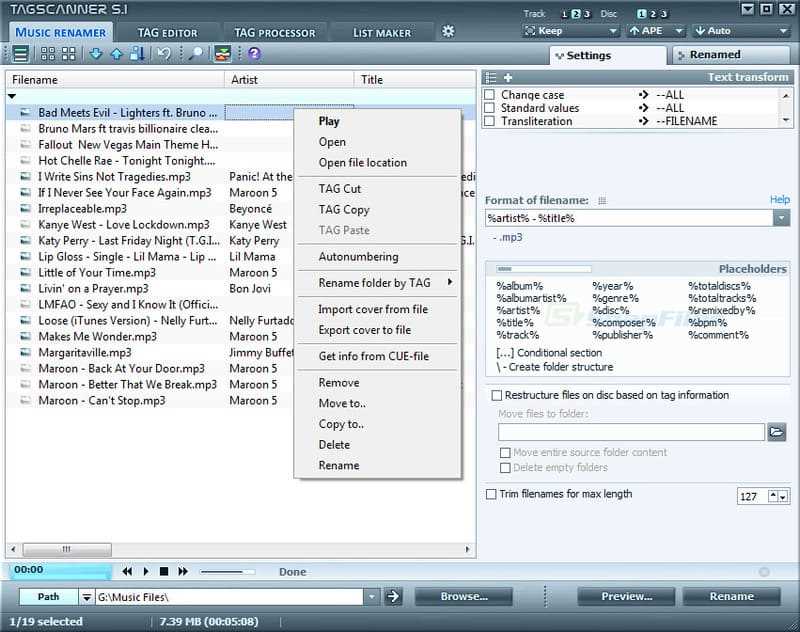
TagScanner is a free and Windows-only audio tag editor built for serious library cleanup. It handles batch editing of ID3v1/v2, APEv2, Vorbis Comments, and more. You can rename files from tags, generate tags from filenames, pull album data and covers from Discogs, MusicBrainz, and freedb, and even create playlists. And it offers useful extras like cover-art resizing and Unicode support.
Best for: Windows users with large or messy libraries who want free batch renaming and online matching.
Platforms: Windows only (portable version available)
Supported formats: MP3, OGG, FLAC, APE, AAC, MP4/M4A, WMA, Speex, WavPack, Opus, TrueAudio, WAV, AIFF, DSD, and more
- Pros
- Strong batch editing and filename-to-tag conversion
- Good online database support (Discogs, MusicBrainz)
- Free and portable
- Wide format and tag-type support
- Playlist creation and cover-art tools
- Cons
- Windows only
- Interface looks dated
- Advanced features (regex, scripts) have a learning curve
Part 6. SongKong – Best for Automatic Collection Cleanup
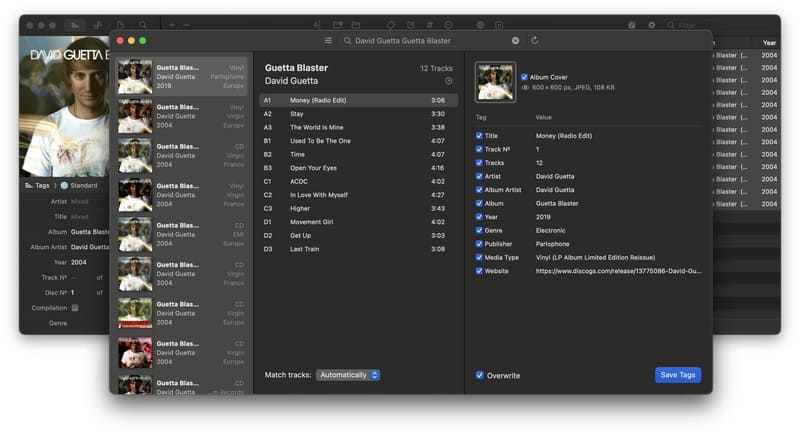
SongKong is designed for fixing an entire music collection with as little manual work as possible. It identifies tracks using AcoustID fingerprints plus MusicBrainz, Discogs, and Bandcamp data, then updates tags, artwork, and filenames. It also finds and manages duplicate songs and can process libraries of any size.
Unlike album-by-album tools, SongKong is built for unattended or semi-automatic runs across large folders. You can preview changes before applying them, and it keeps detailed reports.
Best for: Users with large, messy collections who want automated matching, duplicate cleanup, and high-quality artwork with minimal hands-on work.
Platforms: Windows, macOS, Linux (desktop + web UI)
Supported formats: Most common formats including MP3, FLAC, M4A, OGG, WAV, and others supported by its matching engines
- Pros
- Strong automatic matching for whole collections
- Duplicate detection and flexible keep/delete rules
- High-quality artwork and rich metadata
- Works on large libraries without album-by-album effort
- Cons
- Less manual fine-grained control than pure tag editors
- Matching still needs review for obscure or unusual releases
Quick Comparison Table for the 6 Music Tag Editors
| Tool | Best for | Platforms | Key strength |
| Mp3tag | Batch editing | Win (free), Mac (paid) | Speed and flexibility |
| MusicBrainz Picard | Accurate ID | Win, Mac, Linux | MusicBrainz + AcoustID |
| AVAide Video Converter | Simple editing + conversion | Win, Mac | Easy UI, wide format support, and versatile toolbox |
| Kid3 | Cross-platform | Win, Mac, Linux, Android | Broad format and platform support |
| TagScanner | Windows cleanup | Windows | Batch + rename |
| SongKong | Auto collection fix | Win, Mac, Linux | Full-library matching |
How to Edit Music Tags Safely
1. Back up first
Copy the files before you start. If a tool writes tags incorrectly or a batch rename goes wrong, you can restore the originals.
2. Work on a test batch
Try your settings on 5-10 files first. Check the results in a player and in File Explorer/Finder before running the same process on hundreds of tracks.
3. Double-check automatic matches
Tools that pull from online databases (Picard, Mp3tag, Kid3, TagScanner, SongKong) sometimes guess wrong, especially with live versions, remixes, or obscure releases. Review the suggested tags before saving.
4. Keep a consistent style
Decide on capitalization, whether you use "feat." or "ft.", and how you handle multi-artist tracks. Applying the same rules across the library makes searching and sorting much smoother later.
FAQs About Music Tag Editors
Can I edit the metadata of MP3 songs on Mac?
Yes. Several options work well on Mac: Mp3tag for Mac (paid), MusicBrainz Picard, Kid3, and SongKong. You can also edit basic fields through Finder's Get Info panel for some formats, or use a privacy-focused online editor for one-off changes.
What features should I look for in a good music tag editor?
Wide format support (at least MP3, FLAC, M4A), batch editing, reliable cover-art handling, and the ability to pull data from online sources if you want automatic tagging. A clear interface and good rename-from-tag tools are also helpful for large libraries.
Does editing music tags affect the audio quality of my files?
No. Tags are separate from the audio stream. Editing the audio file metadata doesn't affect the audio itself, let alone degrade the sound. The only risk is writing incorrect tags or, in rare cases, a buggy tool corrupting the file header – hence the backup advice.
How do you edit music metadata using File Explorer?
In Windows File Explorer, right-click the file (or select multiple files), choose Properties, then open the Details tab. You can edit many common fields there. Changes are written directly to the file. This method is fine for small jobs but lacks the batch power and online lookup of dedicated editors.
Can VLC edit the metadata of an MP3 song?
Yes. VLC Media Player can change some basic details of a single audio file. Go to the Tools menu at the top and select Media Information. Then, you can edit music tags like the title or artist in a pop-up window.
That covers the best music metadata editors available across various platforms! It makes it easy to manage and edit metadata in your music library.
If you want a reliable music tag editor, consider trying AVAide Video Converter. It is a versatile program that handles video conversion and excels at editing music tags. Feel free to share your opinion in the comment section below!
ABOUT THE AUTHOR

Your complete video toolbox that supports 350+ formats for conversion in lossless quality.

 Secure Download